VOL. 10: American Military Studies
February, 2027
Published
432
Pages
25 b&w illus. 5 maps. Notes. Bib. Index.
Features
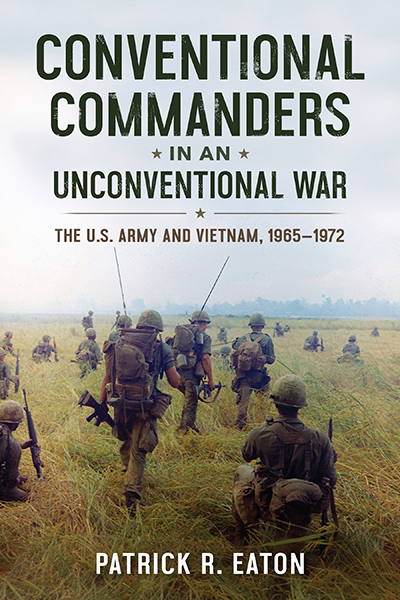
About Eaton's Conventional Commanders in an Unconventional War
Scholarship on the Vietnam War has examined the generals, the strategists, and the politicians. Far less attention has been paid to the officers who actually led battalions, brigades, and divisions into combat—the men who translated national policy into action on the ground. Conventional Commanders in an Unconventional War brings them into focus for the first time.
This is the first study to examine Vietnam-era maneuver commanders as a distinct and cohesive group, spanning the full arc of American involvement from 1965 to 1973. Drawing on more than 160 previously underutilized oral history interviews from the US Army Center of Military History and the Army Heritage and Education Center at Carlisle Barracks, along with after-action reports, operational summaries, and a self-compiled database of more than seven hundred commanders, historian Patrick R. Eaton reconstructs the war from the ground up.
The picture that emerges defies easy judgment. Consider Lieutenant Colonel Gordon Lippman, who had earned a battlefield commission at the Battle of the Bulge, jumped into southern France during Operation Dragoon, and fought in Korea. He died in Vietnam in December 1965, killed by a Viet Cong sniper while walking the perimeter of his unit’s defensive position. Lippman was no outlier. The commanders who led the first airmobile assault at Ia Drang, swept the Iron Triangle during Operation Cedar Falls in 1967, weathered the intelligence failures of the Tet Offensive in 1968, and spearheaded the Cambodian incursion in 1970 were all experienced, adaptive professionals shaped by decades of prior service.
Eaton traces how these officers were forged by the institutional Army of the 1950s—a Cold War bureaucracy oriented toward conventional war and nuclear deterrence—and then thrust into a conflict that demanded something different. He examines how body-count metrics skewed operational incentives, how pacification programs competed with search-and-destroy missions for the same commanders’ attention, how airmobile doctrine matured under fire, and how Vietnamization forced a wrenching reorientation in the war’s final years. Drawing on the candid postcombat reflections of the officers themselves, Eaton argues that US maneuver commanders proved tactically capable and often genuinely innovative, yet they could not bridge the structural gap between battlefield achievement and strategic success. Their story is essential to understanding not just Vietnam but also the enduring limits of American military power.
About the Author
PATRICK R. EATON is a retired US Army Command sergeant major and combat veteran of Iraq and Afghanistan. He has walked the battlefields of South Vietnam and conducted primary-source research at the US Army Center of Military History at Fort McNair and the Army Heritage and Education Center at Carlisle Barracks, where he was awarded the General Matthew B. Ridgway Research Grant in Military History.
American Military Studies: Recent Titles


See all titles in our Series: American Military Studies
Buy Now
Conventional Commanders in an Unconventional War: The US Army in Vietnam, 1965-1973
432 pp. 25 b&w illus. 5 maps. Notes. Bib. Index.
